
Kaitlyn Kendall-Sperry
Senior Consultant
For some, a blank piece of paper is like a canvas ready to be filled with inspiration. For others, that blank piece of paper feels like an abyss. And when that blank piece of paper is supposed to turn into your strategic plan? Even worse. That’s why many of us love a good framework; something to guide those initial thoughts of What should we pay attention to? What matters? What questions should we ask?
When it comes to strategic planning, there are endless frameworks to use for inspiration. The challenge? Most aren’t built for nonprofits.
Common Frameworks for Strategic Planning
There are a variety of frameworks that organizations, both for-profit and nonprofit, use to begin their strategic planning work:
- SWOT (Strengths, Weaknesses, Opportunities, Threats) – A traditional strategic framework commonly used in business.
- SOAR (Strengths, Aspirations, Opportunities, Results) – A variation of SWOT that leans into the planning perspective of Appreciative Inquiry.
- Balanced Scorecard – A framework that looks at Financial Perspective, Customer Perspective, Internal Process Perspective, Learning & Growth Perspective.
- PESTEL (Political, Economic, Social, Technological, Environmental, Legal) – A framework focused on macro-level, external factors.
Nothing is inherently wrong with any of these models. They’re used across the world for a reason: they provide a simple framework to help organizations distill a complex internal and external environment into simple assessment.
While each framework faces individual criticisms, our main concern focuses on their roots: they weren’t built with nonprofit organizations in mind. The critical nuances of nonprofit operations—governance, volunteer engagement, philanthropy, mission impact—can be entirely ignored by these models.
So, what else is there?
A Strategic Planning Framework for Nonprofits
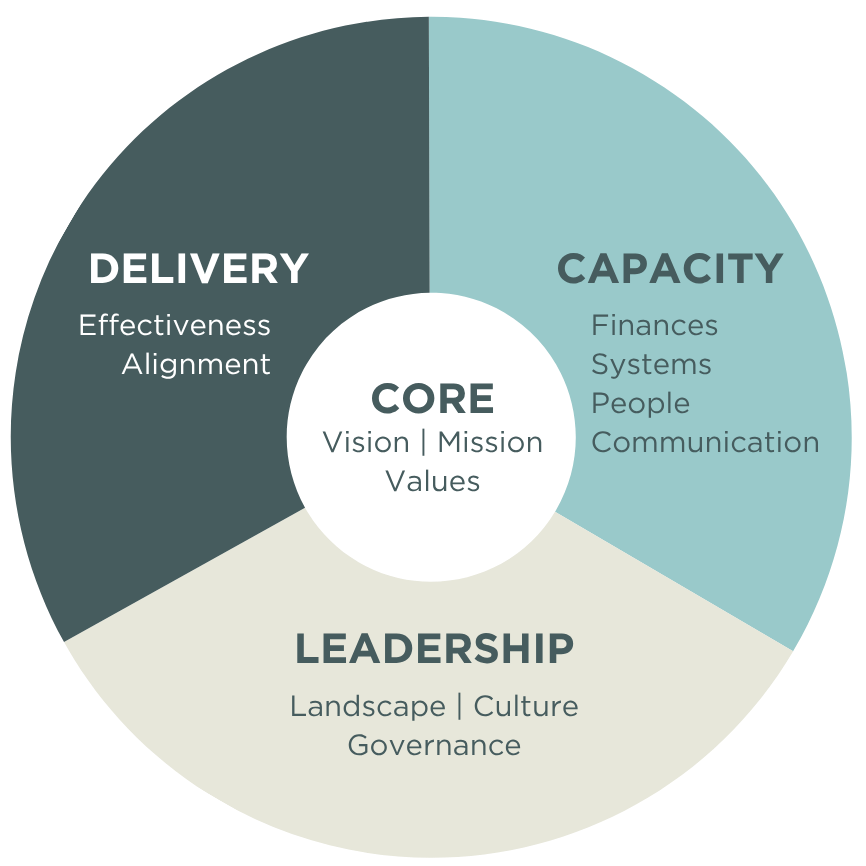
Built based on the knowledge gained from over 25 years of working with organizations, Benefactor Group has developed the LCDC Framework: an in-depth organizational assessment that evaluates nonprofits against leading practices, so you can understand where you’re thriving and where you need to grow.
Core – Vision, Mission, Values
The foundational elements of any nonprofit.
Delivery – Effectiveness, Alignment
The programs and services that allow organizations to deliver on their mission.
Capacity – Finances, Systems, People, Communication
The enabling factors that support sustainable operations.
Leadership – Landscape, Culture, Governance
The areas that push an organization from “doing okay” to “thriving.”
LCDC Framework in Action
In its complete form, the results of LCDC Framework gives you a blend of qualitative and quantitative data in each of the categories and subcategories broken down by your key audiences—board, staff leadership, general staff, volunteers, clients, etc.
How can the LCDC Framework help you?
Use it for inspiration.
As you consider what you want to learn about in your strategic planning discovery, use the LCDC Framework to narrow (or expand) the focus of your work.
Use it to align expectations.
Strategic planning can mean different things to different people—the LCDC Framework gives you a common language.
Use it to organize your thoughts.
Even if you’ve already completed your discovery work, the LCDC Framework has four (or 12) buckets to help you document what you’ve found.
Use it to connect strategy to support.
The LCDC Framework helps you tie your strategic priorities directly to the fundraising and stakeholder relationships that will sustain them.
Beyond Strategic Planning
While we built the LCDC Framework to support strategic planning discovery, that isn’t where its value ends. Consider the following situations:
You’re a new CEO or Executive Director. You learned as much as you could during the interview process, but it’s still difficult to feel like you have a real understanding of where the organization is today. The LCDC Framework gives you a complete view of where the organization is thriving and where it still needs to grow.
Imagine you’ve gone through a major disruption like COVID and are starting to return to a steady state. Where are we now after months (or years) of constant adaptation, stress, and uncertainty? The LCDC Framework gives you an understanding of your new normal, so you can appropriately plan for the next stage of your organization’s journey.
Think about a transformational, unrestricted gift from a donor. Their only desire is for your organization to thrive and your impact to expand. How do you decide where to distribute those funds across your organization? The LCDC Framework helps you make sense of where internal investment could have the most impact and support long-term sustainability.
A long-tenured CEO is preparing to retire and the board chair wants a better understanding of where the organization is to inform succession planning. The LCDC Framework provides a nuanced understanding of what needs to be done prior to and after finding a new leader.
The LCDC Framework isn’t just for strategic planning, it’s a lasting resource for thinking clearly about your organization, creating long-term impact, and keeping strategic thinking at the center of how you operate.
Partner with Strategic Planning Experts for Nonprofits
Strategic planning can be some of the most pivotal work an organization can pursue. A good plan gives you the ability to say yes and, more importantly, to say no. It becomes a magnifying glass that focuses your work and transforms your impact. When it comes to such important work, trust resources built for nonprofits by people who know nonprofits.
Interested in learning more about the LCDC Framework and how it can be applied inside or outside of strategic planning? We’d love to talk!