

Kaitlyn Kendall-Sperry
Senior Consultant
“We don’t have time for strategy; we’re just trying to survive.” I heard this quote from a nonprofit leader, in response to the dramatic turmoil facing nonprofits in 2025 (or as our founder, Laura MacDonald, labeled it—“a cosmic game of Whac-A-Mole“). I took two things from the leader’s statement. First, we’re in crisis response mode. And second, strategy slows us down.
To address the first point: we can’t deny that it feels like we’re in a state of perpetual uncertainty, particularly in the nonprofit sector. The world has always been changing to some extent, but recently it feels like the scope and frequency of those changes has increased dramatically. We’ve seen this transition reflected in how organizations address their strategy. Strategic plans used to span 15 years, then dwindled to 10 years, 5 years, and, finally, 3 years. Today, we have clients wanting to plan no further than the next 12 to 18 months.
To address the second point: strategy, when done right, should never slow you down. It should be built into the very DNA of how you operate. Since no one can (reliably) predict the future, we recommend building organizational practices that support thoughtful adaptation in response to challenges. These practices don’t just support the work of your strategy, they can also be used to plan for disruptions to your operations and programs.
Here are a few things you can do to ensure your organization is ready to adapt, rather than react in uncertain times.
Prioritize your work and be realistic about what can get done.
Whether it’s your everyday operations or your strategic projects, some things are more important than others. Trying to deny it is a recipe for dropped balls, missed deadlines, and overburdened staff. Begin by prioritizing your work. Some activities are essential. (Think about the first things you got up and running during the COVID shutdown.) This could include critical operational tasks, legally required activities, strategic communications to internal and external stakeholders, and/or programming that provide essential services to clients. Each organization’s list will look slightly different.
Follow your prioritization with a gut check – is our essential work too much? Can we get it all done with fewer resources? If not, what contingency plans do we need to put in place to make sure our essential work is covered? The natural inclination of nonprofits is to say, of course we can do it all. We are a sector of abundant, dedicated people who love serving our communities. But as these disruptions become more frequent, we must be realistic about how far we (and our teams) can stretch.
Meet regularly to discuss critical topics and maintain accountability.
We all dread the meetings that could have been emails. But meeting every week or two to discuss strategic issues, opportunities, and risks is worth the time. Keep the agenda tight, focusing on solving important challenges, celebrating wins, and managing accountability. Expand the scope once a quarter and spend a half day reflecting on the successes of the last 90 days and planning for the next 90 days. Finally, once a year, take a day for a comprehensive look at your strategy, adapt it based on your current environment, and prioritize for the coming year.
Set these meetings at the start of the year, don’t cancel, and reschedule to keep from skipping when availability doesn’t align. Having them on the calendar means that there’s a continuous eye on your strategy and the state of the organization.
Manage risk proactively.
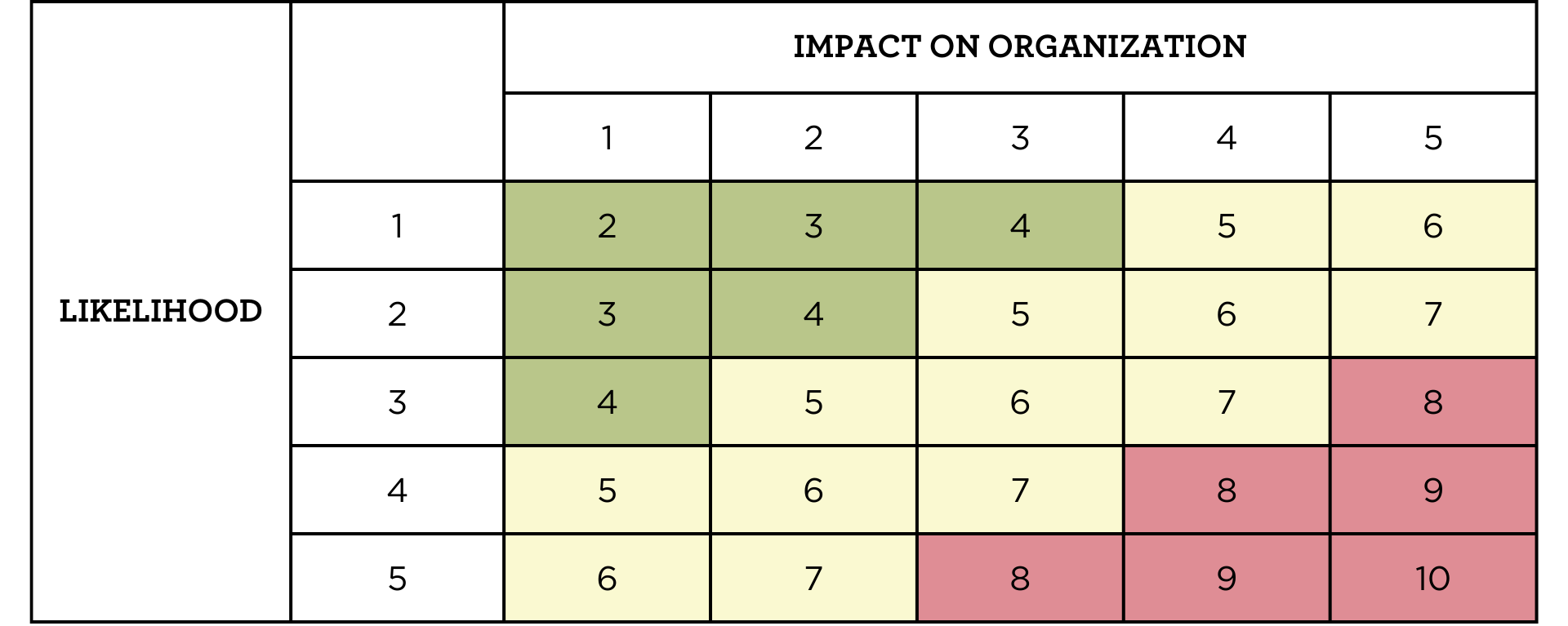
You can’t predict (and proactively plan for) every situation. There isn’t enough time in the day, and no one has a crystal ball. But you can prepare for those that are most likely and most impactful. Try this simple exercise to help keep potential risks on your radar.
- List out the potential risks facing your organization. This could be funding cuts, changes to key legislation, partner closures, government shutdowns, or anything else relevant to your work.
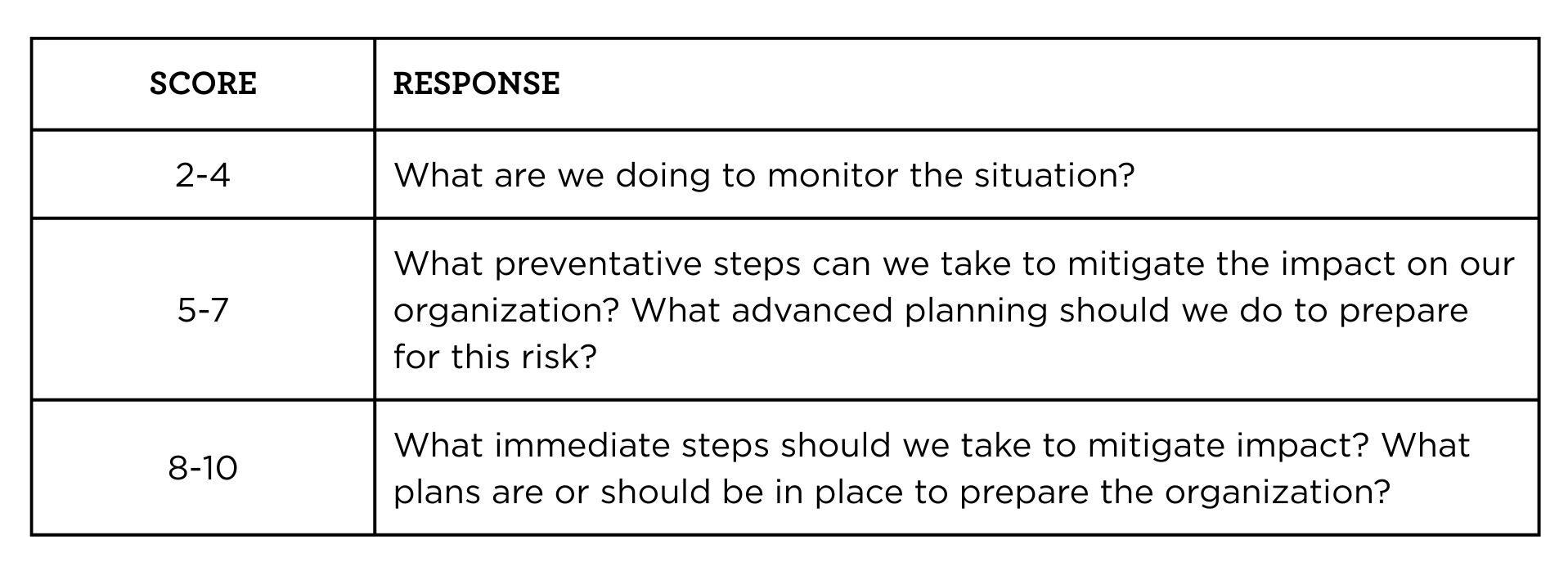
- Use a table to evaluate two criteria: “How likely is it that this will happen?” and “How impactful would it be on our organization if it happens?”. Score each risk on a scale of 1 (very unlikely/very low impact) to 5 (very likely/very high impact), then add up the scores. This should be an exercise you complete in partnership with the board.
- React and plan based on the scores.
- Re-evaluate regularly. As we’ve established, things change quickly. Don’t be afraid to revisit this exercise as needed to ensure you are prepared.
Communicate effectively and with clarity.
Whether it’s your staff, your donors, your board, or anyone else close to your organization, be proactive with your communication. As Benefactor Group’s Communications team writes, in times of disruption, “causes must communicate with urgency, clarity, and conviction.” Clear messaging communicates that your organization and its leadership have a handle on what’s going on and a plan to move forward.
Don’t forget—the moles always win.
Calling back to Laura’s article, the nonprofit sector isn’t new to challenges. Whether it’s a pandemic, a government shutdown, a historic weather event, or a recession, nonprofits have survived and thrived. We are a resilient sector, built across thousands of communities, through the passion of millions of individuals, and creating endless moments of generosity, service, and hope.
Interested in implementing some of these in your organization? Revisiting your strategic plan during these uncertain times? Let’s chat.