

Kelly Quilter, CFRE
Vice President
In the nonprofit world, moments like leadership transitions, funding shifts, and other curveballs are inevitable. But what happens when they occur mid-campaign? In these moments, it’s common for organizations to pause and consider: Should we slow down? Reassess? Wait this out?
These are fair questions, but not always the best path. Because if history tells us anything, it’s that giving is resilient.
Capital Campaigns and Crisis: What the Data Actually Shows
Over the last two decades, giving has remained resilient through several crises: the Great Recession, major tax law changes, and a global pandemic. Consider the latter. When Covid-19 hit, development and advancement professionals held their breath—some paused their fundraising efforts, waited for direction, or abandoned them entirely. Yet 2020 and 2021 reached unprecedented heights in philanthropy.
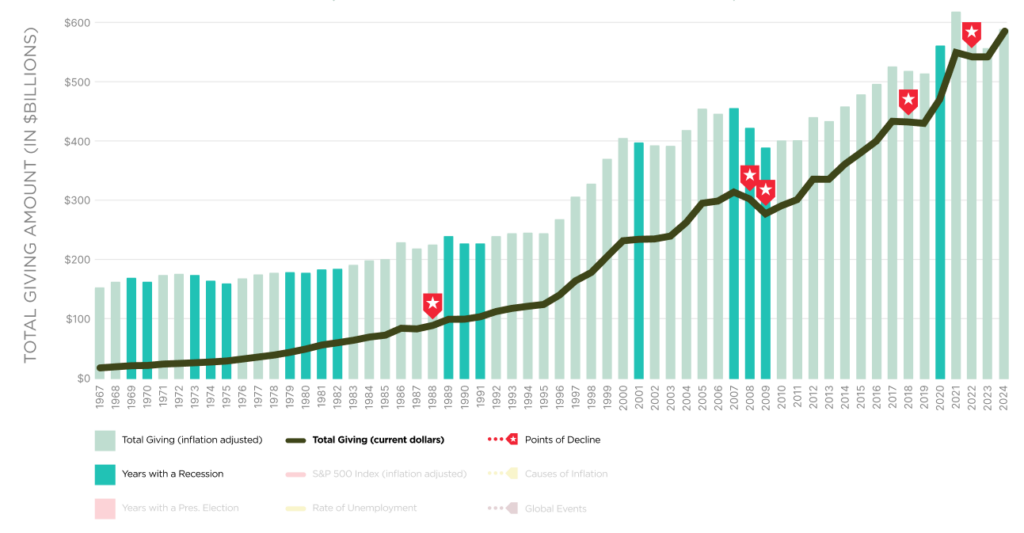
Even in years of decline, the data tells a story of remarkable durability. Since 1967, total giving has fallen by 1% or more in current dollars only five times. Several of which followed significant changes to tax policy, which might give us a preview of what is to come in 2026 (for more insights, check out our recommended tactics to avoid a tax-induced windfall, and stay tuned for our annual Giving USA infographic that will come out soon).
The pattern is clear: while giving may fluctuate in the short term, generosity has an extraordinary track record of bouncing back. And when need is clear and leadership is confident, it doesn’t just recover; it accelerates. Donors don’t disappear in difficult moments. They look for organizations worthy of their trust and investment.
Note: Recovery patterns vary by sector. Explore nonprofit sector-specific resilience data in our interactive Giving is Resilient series.
What Stalls a Capital Campaign (And How to Recover)
Rarely does a campaign fail because of what’s happening in the world. It fails because of what starts happening inside the organization in response.
The culprit is rarely a single decision. It’s the slow erosion of momentum. Leadership begins second-guessing the goal. Solicitations get pushed. Messaging softens. Donor conversations become fewer and farther between. The team shifts from proactive to reactive, waiting for conditions to feel right before moving forward.
Campaigns are long, complex efforts that run on forward motion. When that motion stalls, even briefly, the effects compound. A delayed ask doesn’t just push back one gift. It disrupts sequencing, cools relationships, and sends an unintended signal to donors that the organization isn’t sure of itself. We’ve seen this pattern before — and it’s instructive.
The good news? Campaigns don’t require perfect external conditions to succeed. They never have. What they require is disciplined, consistent strategy and the organizational confidence to keep moving when the path feels uncertain. That confidence, more than any market condition or headline, is what donors are watching for.
Not sure where to start? Our Crisis Response Playbook and Fundraising in the Age of Disruption offer practical guidance for keeping campaigns on track when the external environment gets noisy.
When a Crisis Hits During a Campaign, It’s Time to Adjust…and Keep Moving.
Here’s what that looks like in practice:
1. Reground Your Case for Support
A strong case for support is not a static document. In a moment of disruption, it becomes more relevant, not less. Revisit it with fresh eyes. What has changed? What is more urgent? What is at risk if action isn’t taken now? Donors are paying attention to the world around them. Your case should reflect that you are too. Clarity isn’t just helpful in these moments. It’s persuasive.
2. Make Smart “Quiet Phase” and Goal Decisions
If you haven’t launched publicly yet, use the uncertainty productively. Extend the quiet phase to deepen relationships, secure additional lead gifts, and refine the case. A longer quiet phase is not a failure of nerve. It can be a competitive advantage.
If the external environment shifts significantly, be willing to have an honest conversation about the goal. Distinguishing between pausing and recalibrating matters. A thoughtful goal adjustment is strategic. An indefinite pause is how campaigns lose momentum they never recover.
3. Triage Your Pipeline Before You Pull Back
Not every donor in your portfolio is equally affected by a crisis. Before slowing down, slow down strategically. Segment your prospect pool by readiness, relationship warmth, and financial capacity. Identify who is closest to a decision and accelerate those conversations. Look for donors who may actually be more motivated to give during a crisis: those who are mission-aligned, emotionally connected, and financially insulated. Crisis has a way of clarifying priorities for donors just as much as it does for organizations.
4. Increase Communication
Silence creates uncertainty. Uncertainty can slow giving. During moments of crisis, organizations should communicate more frequently and more directly.
Leadership updates, targeted donor communications, and visible proof points of progress all signal that the organization is steady and the work is continuing. Keep volunteer leaders engaged with meaningful roles and clear asks. In moments of disruption, communication isn’t just good donor relations. It’s campaign infrastructure.
5. Don’t Stop Asking for Campaign Gifts
One of the most common missteps is pulling back on solicitations during a crisis. However, donors don’t expect you to disappear in these moments, rather they want to know where they fit.
Continue to engage with leadership donors personally and advance gift conversations that are already in motion. For donors who are hesitant, explore flexible pledge structures and extended payment timelines. A well-timed, well-framed ask during a moment of need is not insensitive, it’s necessary.
If your campaign has the right relationships in place, a challenge match or bridge gift opportunity can re-energize momentum and signal confidence to the broader donor pool. Leadership gifts don’t just fund campaigns. They give other donors permission to act.
6. Stay Anchored to the Long-term Vision
Campaigns are, by definition, a vision for the future. Even as you respond to immediate needs, keep connecting donors back to the bigger picture: What are you building? What will be different because of this effort? Why does it matter beyond this moment? Urgency may open the door. Vision is what sustains commitment.
A Different Way to Think About Crisis in Fundraising
It’s easy to view disruption as a threat to a campaign. But in reality, it’s often a stress test of the foundation you’ve already built.
Is the case clear? Is leadership aligned? Are donors engaged? Are systems in place to track and respond? Organizations that have done this work well are not derailed by crisis. They are activated by it. When disruption hits, they don’t pause until conditions improve. They adapt while continuing to move forward.
The organizations that come out of uncertain moments ahead are the ones that kept communicating, kept engaging, and kept fundraising. Not recklessly. Strategically. Success during a campaign crisis doesn’t come from waiting for stability. It comes from leading with clarity and continuing to move when it matters most.
Every Campaign is Different. Let’s Talk About Yours.
We’ve worked with organizations navigating campaigns through recessions, pandemics, leadership transitions, and everything in between. If you’re facing uncertainty right now or want to stress-test your campaign before disruption finds you, we’d love to connect. Reach out to our team to swap stories, share what you’re seeing, or just think through your options with someone who’s been there.