

Jenny Bergman
Senior Consultant
Nonprofit board members are often recruited for what they bring. Their expertise, their networks, their lived experience, their judgment. They are lawyers, accountants, real estate developers, educators, physicians, entrepreneurs. People who know things. People with opinions.
And that is a good thing.
The real magic of a strong board happens when members are able to use both of the hats they wear to the fullest, without confusing one for the other.
The Two Hats Board Members Wear
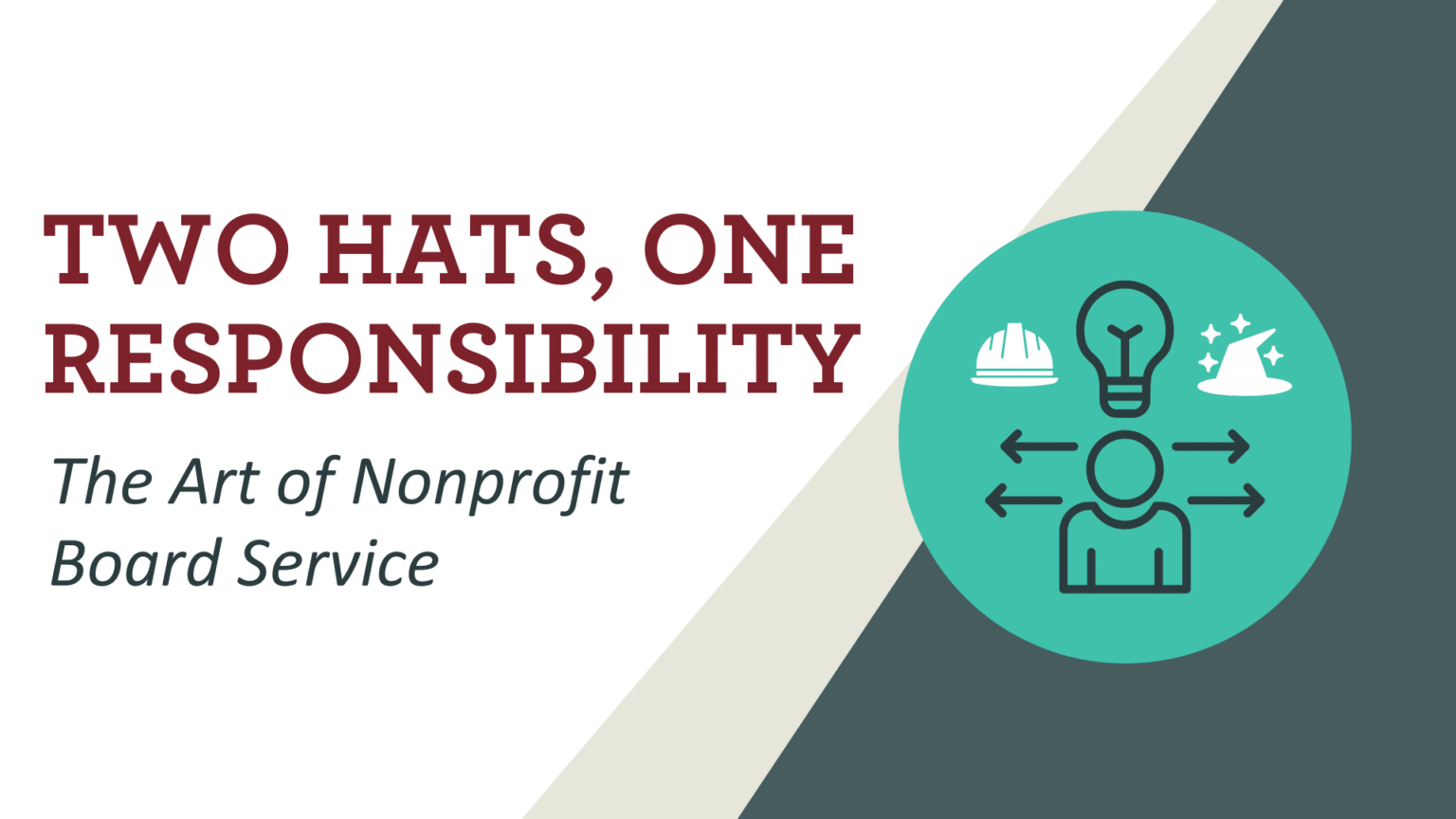
Every nonprofit board member wears two distinct hats.
The first is the governance hat.
This hat is non-negotiable and universal. Under it, every trustee, regardless of background, is a fiduciary, a steward of mission, and the chief executive’s boss. Governance is about oversight, strategy, accountability, sustainability, and long-term impact. It is exercised together, not individually, and it is grounded in duties of care, loyalty, and obedience.
The second hat is the expertise hat.
This is the hat that reflects why many board members were invited to serve. It includes professional skills, organizational understanding, community insight, and life experience. This hat is valuable precisely because it brings perspectives that staff may not hold and questions that insiders may not think to ask.
When both hats are used well, and intentionally, the organization benefits enormously.
Why Board Member Hat Confusion Is So Common
People love to give their opinions. That is human. And in nonprofits, board members are not just casual observers. They are trusted members of the team who care deeply about the mission and want the organization to succeed.
Complicating matters further, many board members do not come from the nonprofit sector. They arrive from corporate, legal, medical, academic, or entrepreneurial environments where authority, accountability, and decision-making look very different. Yet they are often expected, implicitly, to understand how all nonprofits work.
Nonprofit governance is different.
It has nuances that do not always translate neatly from other sectors. Volunteer leadership, shared authority, constrained resources, donor expectations, public trust, regulatory requirements, and the unique board and CEO partnership all shape how nonprofits function. Without orientation and ongoing clarity, even the most well-intentioned trustees can default to what they know. They step into operational problem solving, offer directives instead of questions, or assume that expertise confers authority.
That is where things can get muddy.
Board Governance First, Always
The governance hat is always on.
When wearing it, board members are not acting as individual experts but as collective stewards. A lawyer is not the lawyer for the organization. A finance professional is not the CFO. A marketing executive is not the communications department. Each brings perspective, but none substitutes for staff roles or management accountability.
Under the governance hat, the board focuses on:
- Setting direction, not running programs
- Hiring, supporting, and evaluating the CEO
- Ensuring financial health and ethical integrity
- Asking the right questions, not supplying all the answers
Strong governance creates clarity, trust, and space for staff to do their work well.
The Expertise Hat: Powerful, but Best When Invited
The expertise hat is not less important. It simply operates differently.
This hat is most effective when it is offered, not imposed. When expertise is shared through thoughtful questions, scenario testing, and systems thinking, it sharpens decision-making. When it is deployed without context or invitation, it can unintentionally undermine staff confidence and blur lines of accountability.
High-functioning boards make room for expertise by:
- Clearly distinguishing governance discussions from advisory ones
- Using committees and task forces with defined scope and authority
- Encouraging board members to signal which hat they are wearing
- Allowing the CEO to invite specific expertise at specific moments
This discipline does not diminish contribution. It elevates it.
Where the Real Board Governance Magic Happens
The real magic happens when board members fully embrace governance and skillfully deploy their expertise in service of it.
It happens when trustees understand that nonprofit governance is its own practice. It is not a watered-down version of corporate leadership, and it is not a volunteer advisory group either. It happens when boards honor the difference between oversight and execution, between accountability and control, between contribution and interference.
When both hats are used intentionally, boards become more than well-meaning. They become effective. They become trusted partners to leadership. And they create the conditions for nonprofits to thrive in complexity, not despite it.
A Final Thought
The question for board members is not whether they have something valuable to offer. They almost always do.
The question is, which hat am I wearing right now, and is it the one the organization needs most?
When boards can answer that question honestly and consistently, everyone wins.
Benefactor Group invites you to have an in-depth conversation around your organization’s board and how an outside perspective can help create board governance magic. Let’s talk.
A Guide to Using Two Hats
Small, intentional shifts can dramatically improve how boards use both hats to get you started.
Name the Two Hats Out Loud
Make the distinction explicit. Add language to board orientation and meeting norms that clearly defines the governance hat and the expertise hat, and when each is appropriate. Language creates permission and boundaries.
Tips and Tricks: At the start of a meeting or discussion, normalize phrases like: “Speaking with my governance hat on…” or “Putting on my professional hat for a moment…”
Reset Expectations in Board Orientation
Do not assume board members, especially those new to nonprofits, understand nonprofit governance. Build in time to explain how nonprofits differ from corporate or professional environments, including the shared authority model and the board and CEO partnership.
Tips and Tricks: Send a short follow-up email or include a 15-minute refresher at the next board meeting focused solely on governance roles.
Tighten Committee Charters
Committees are where hat confusion often shows up first.
Tips and Tricks: Review committee charters to clarify authority versus recommendation, define when staff is supported versus directed, and specify time-bound or purpose-driven advisory roles.
Committees should extend governance, not replace management.
Empower the CEO to Invite Expertise
The CEO and board members work in partnership and the greatest gift a board member can give a CEO is thought partnership.
Tips and tricks: Create agreed upon boundaries that focus on targeted expertise and operational advice only when helpful.
This reinforces trust and preserves accountability.
Evaluate Board Performance Through a Governance Lens
When boards assess themselves, they often ask whether members are engaged. A better question is whether members are appropriately engaged.
Tips and Tricks: Ask these questions: Do we stay at the right altitude? Do we use expertise to inform decisions without overruling staff? Are we governing collectively or acting individually?
Remember Why People Were Invited
Board members were asked to serve because they care, because they bring perspective, and because they are trusted.
Honoring that trust means giving them clear lanes to contribute and the discipline to stay in them.
Tips and Tricks: Ensure each board member understands their roles and responsibilities.