

Joey Scheiber
Senior Consultant
If you’ve ever had a role in hiring staff, you’ve probably asked candidates for cover letters. But have you ever thought about why? How important are they? Do they still add value in today’s world? What role should cover letters play (or not) in the selection process?
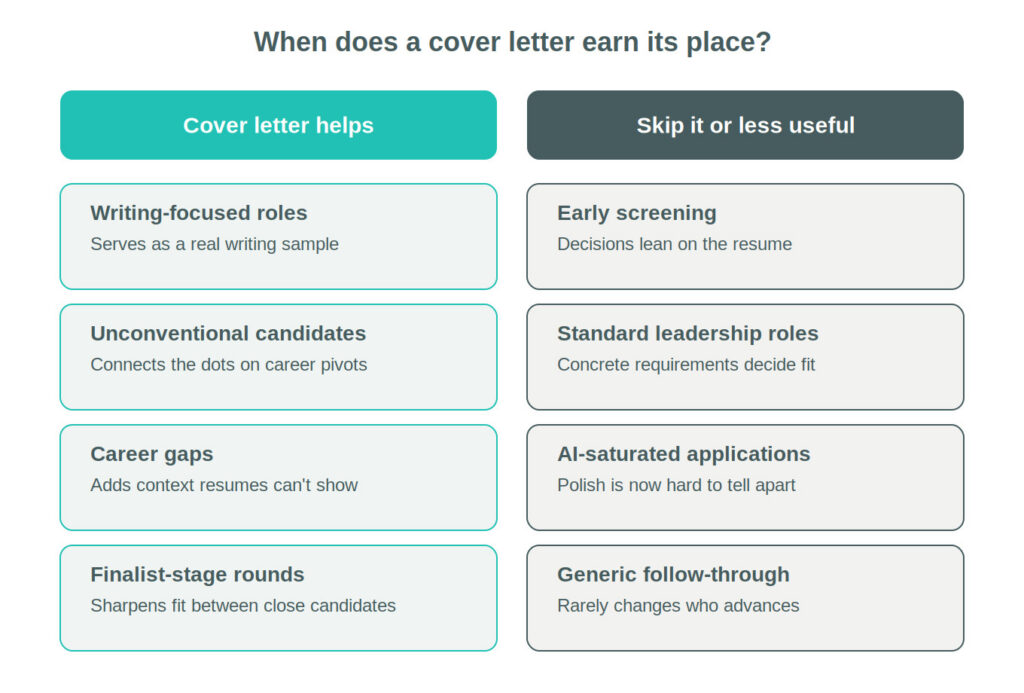
While the answers to these questions aren’t always straightforward, Benefactor Group has recently taken the approach of not requiring a cover letter as part of an initial application. Cover letters can add value to the hiring process, but not necessarily in the early phases of a search when the goal is to determine which candidates will advance to a screening conversation.
How AI Is Changing the Cover Letter and What It Means for Nonprofit Hiring
In recent years, with the rise of AI, we have seen significant dilution in the value of a cover letter. Recent LinkedIn surveys show over 50% of new job applicants are using AI to draft cover letters and resumes.
Until the past few years, the primary argument in favor of cover letters was that they add a human element to what can otherwise be a rote procedure, offering hiring managers a spark of the applicant’s personality that a standard resume cannot capture. This is exactly what tools like Chat GPT remove from the equation.
For all its advantages—speed, polish, and precisely-articulated statements of interest that cleanly tie a candidate’s interests and experiences to the required qualifications—AI rarely captures the genuine passion that can distinguish a solid candidate from an exceptional one.
Ask any recruiter working today, and they’ll likely tell you that cover letters are becoming increasingly standardized: so smooth, error-free, well-written, and consistently formatted that it’s nearly impossible to tell them apart.
Search firms have taken various approaches to combating this, with some requesting candidates abstain from using any AI at all in their application materials or even planting easter eggs in position descriptions to catch AI use. Given how thoroughly the technology has worked its way into our modern lives (not to mention the sheer amount of time it takes to identify, apply, and interview for a new role), it’s unclear how long strategies to restrict AI use are going to remain viable, much less desirable.
Do Cover Letters Actually Influence Hiring Decisions?
AI aside, it’s unclear how frequently cover letters are actually used to make hiring decisions. I’ll freely admit that in my own experience, I usually make initial decisions on who to interview based primarily on what’s in a resume, not a cover letter.
Most of the roles I recruit for are leadership positions, and these typically come with a set of concrete requirements (years of work, sector experience, level of responsibility), and candidates who lack those qualifications won’t be a fit regardless of how well they write or how passionate they are about the institution.
When a Cover Letter Helps: Writing Roles, Unconventional Candidates, and Career Gaps
There are certainly situations in which a cover letter can be an asset, both to candidates and to the hiring organization. One obvious exception is when a role itself is a writing-focused position where the cover letter can serve as a writing sample specific to the hiring organization.
In these instances, it can be helpful for the organization to offer more direction for the candidate about the format and the content of the letter to ensure it includes information that is helpful in making a hiring decision. This is an instance where an organization may fairly choose to prohibit AI use entirely or request that candidates disclose exactly how they used AI to generate their response.
There are times, too, when a cover letter can provide significant value to candidates – particularly those with unconventional experience.
While gaps in one’s resume are not the red flag they once were, it can be helpful for the candidate to offer additional context for their professional moves. Sometimes the best person for a job is someone who hasn’t worked in several years because of family circumstances, or who is making a major but strategic pivot between fields, or whose past career choices seem disjointed on paper but make sense within the larger context of their lives.
In instances like these, cover letters can help to connect the dots that would otherwise read as red flags to a recruiter and prevent a strong candidate from falling through the cracks. Cover letters can also serve as an opportunity for candidates to mention a personal referral if they have one or a close connection to the organization’s mission that might not otherwise be apparent.
When a Cover Letter is Necessary in an Executive Search
Finally, even for processes that do not require a cover letter, in later stages of a search it can be helpful for a candidate to go through the exercise of writing one. By this point, candidates have typically had several conversations with the recruiter and ample time to learn more about the organization, so their thoughts on why they are a fit have likely evolved since they first saw the posting and applied.
By putting pen to paper and synthesizing all of the organizational intel they’ve gathered with their own reasons for pursuing the job, they’ll arrive at a deeper understanding of what it would realistically feel like to step into the role and walk away with more articulate talking points on why they are the best choice.
Late-in-the-process cover letters can also serve as helpful tools for a search committee who is struggling to differentiate between two or three extremely qualified, close-fit candidates.
The Bottom Line: Rethinking When (And Why) To Ask for a Cover Letter
The value of the cover letter isn’t fixed. It’s an ongoing question, and AI is only accelerating how quickly it’s evolving, particularly as the technology gets better at mimicking not just polish but personality.
Search firms and hiring organizations will need to keep revisiting where (or if) in the process a cover letter still earns its place, and what they’re really trying to learn from it when they ask for one.
Let’s talk if you want to dive deeper into our when and why for cover letters. We love to chat about all things nonprofit talent.